Prostate Health Index (PHI) - Evidencio
Prostate Health Index (PHI)

The Prostate Health Index (PHI) is a prediction model based on three prostate biomarkers that can accurately estimate the probability of (clinically significant) prostate cancer.

Les auteurs de la recherche: William J. Catalona, Alan W. Partin, Martin G. Sanda, John T. Wei, George G. Klee, Chris H. Bangma, Kevin M. Slawin, Leonard S. Marks, Stacy Loeb, Dennis L. Broyles, Sanghyuk S. Shin, Amabelle B. Cruz, Daniel W. Chan, Lori J. Sokoll, William L. Roberts, Ron H. N. van Schaik, Isaac A. Mizrahi
Version: 1.0
  • Public
  • Urologie
  • {{ modelType }}
V-1.0-10531.26.03.23
(01)08720938015175(8012)v1.0(4326)260323(240)10531
Télécharger le Manuel de l'utilisateur et consulter le Utilisation prévue.
  • Algorithme
  • Détails
  • Utilisation prévue
  • Label électronique
  • Notes de mise à jour
  • Manuel de l'utilisateur
  • {{ toolbarErrorMessage }}

Unités

{{ section.title }}

{{ section.description }}

Calculer le résultat

Définir d'autres paramètres pour effectuer le calcul

The Prostate Health Index (PHI) score is:

{{ resultSubheader }}
{{ $t('download_result_availability') }}
{{ chart.title }}
Intervalle de résultats {{ additionalResult.min }} à {{ additionalResult.max }}

Informations conditionnelles

Votre ou vos saisies ont été modifiées. Veuillez mettre à jour votre résultat. Mettre à jour

The cut-off values and corresponding probabilities of (clinically significant) prostate cancer are derived from Catalona et al. (2011) using the Beckman Coulter Access Hybritech PSA Calibrators. Optimal cut-offs and probabilities differ between patient populations, such as (but not limited to) patients eligible for biopsy or radical prostatectomy, regions, PSA calibrators, and patient ethnicities. Please consult local clinical guidelines or external validation studies to choose the appropriate cut-off and probability.

{{ file.classification }}
PRO
Note
Les notes ne sont visibles que dans le téléchargement des résultats et ne sont pas sauvegardées par Evidencio.

Les calculs seuls ne doivent jamais dicter les soins aux patients et ne remplacent pas le jugement professionnel. Voir notre disclaimer.

Algorithmes sous-jacents Une partie de
logo

Veuillez vous connecter pour activer les fonctions d'impression d'Evidencio

Pour utiliser les fonctions d'impression d'Evidencio, vous devez être connecté.
Si vous n'avez pas de compte communautaire Evidencio, vous pouvez créer un compte personnel gratuit à:

https://www.evidencio.com/registration

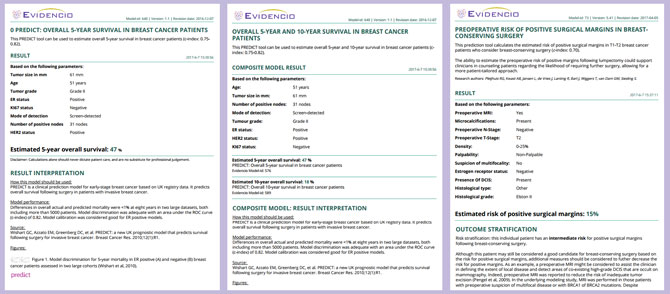
Résultats imprimés - Exemples {{ new Date().toLocaleString() }}


Avantages du compte communautaire Evidencio


With an Evidencio Community account you can:

  • Create and publish your own prediction algorithms.
  • Share your prediction algorithms with your colleagues, research group, organization or the world.
  • Review and provide feedback on algorithms that have been shared with you.
  • Validate your algorithms and validate algorithms from other users.
  • Find algorithms based on Title, Keyword, Author, Institute, or MeSH classification.
  • Use and save prediction algorithms and their data.
  • Use patient specific protocols and guidelines based on sequential algorithms and decision trees.
  • Stay up-to-date with new algorithms in your field as they are published.
  • Create your own lists of favorite algorithms and topics.

A personal Evidencio account is free, with no strings attached!
Join us and help create clarity, transparency, and efficiency in the creation, validation, and use of medical prediction algorithms.


Clause de non-responsabilité : les calculs ne doivent jamais dicter les soins aux patients et ne remplacent pas le jugement d'un professionnel.